The Science of Love: Why Logic Doesn’t Fix a Relationship Argument
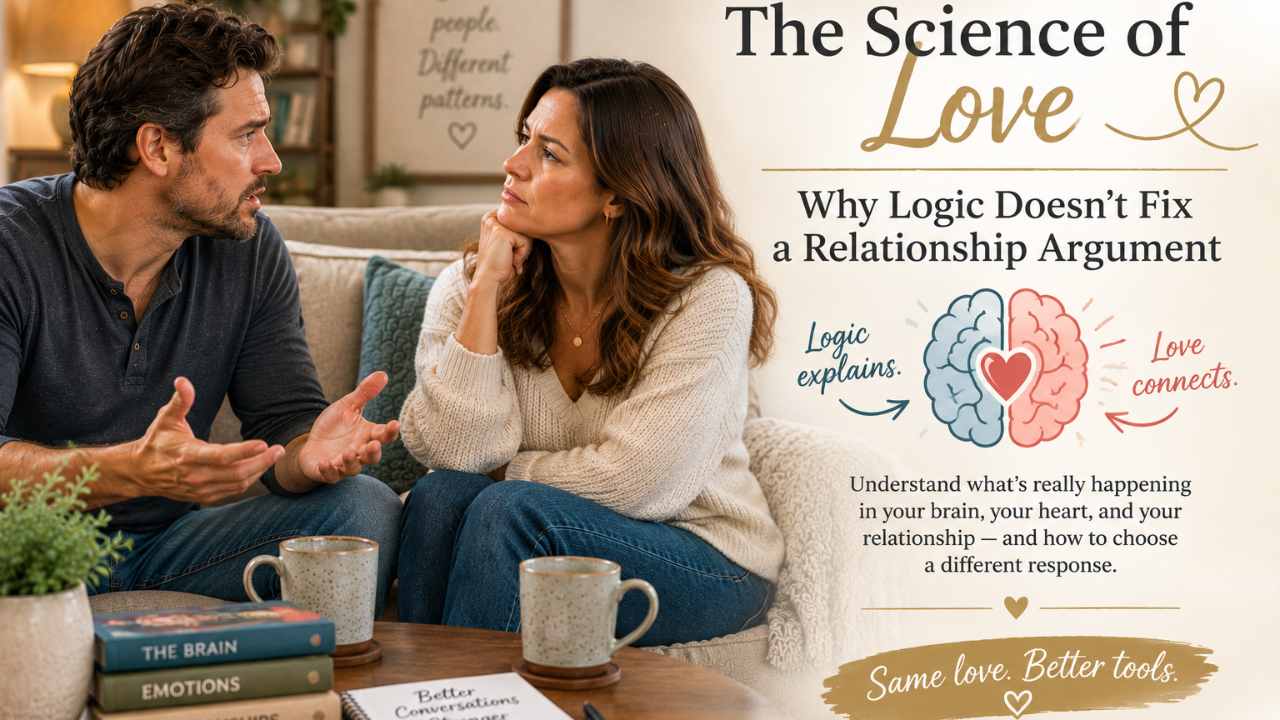
Have you ever been halfway through an argument with your partner and thought:
If I could just explain this clearly enough, they would understand.
So you explain.
Then you explain it another way.
You provide examples. You clarify what you meant. You point out what actually happened. Maybe you even reconstruct the entire conversation in chronological order.
And somehow, instead of solving the problem, you are now having a bigger argument.
How can two intelligent people who love each other become completely unable to resolve something that seems as though it ought to be solved with a little logic?
Because sometimes the argument isn't really happening at the level of logic.
It's happening at the level of connection.
The Argument You’re Having May Not Be the Argument You’re Having
Couples argue about perfectly ordinary things.
- Money.
- Housework.
- Parenting.
- Schedules.
- Phones.
- Sex.
- Being late.
- Who forgot to do something.
- Who said what and how they said it.
But underneath those practical disagreements can be something much more important: the meaning we attach to what is happening between us.
Do I matter to you?
Are you there for me?
Can I count on you?
Do you understand me?
Are we okay?
Emotionally Focused Therapy, or EFT—the approach behind the Hold Me Tight® program—is grounded in attachment theory and focuses on the emotional bond between partners rather than treating relationship distress as simply a communication problem. Research has identified EFT as an evidence-based approach to couples therapy, with studies showing improvements in relationship satisfaction.
That helps explain why a perfectly logical response can sometimes land so badly.
Your partner may be talking about the dishes.
But emotionally, they may be asking whether they matter.
Why “But That’s Not What Happened” Rarely Helps
Imagine your partner says:
“You never listen to me.”
Your logical brain immediately identifies the problem.
Never? That's obviously not true.
You listened yesterday. In fact, you can name three conversations from this week alone.
So you respond:
“That's ridiculous. Of course I listen to you.”
Technically, you may be absolutely correct.
Relationally?
You may have just missed the entire conversation.
Because “You never listen to me” may actually mean:
I don't feel heard right now.
And now one person is trying to prove the accuracy of the statement while the other is trying to communicate the feeling underneath it.
You aren't necessarily disagreeing about the same thing anymore.
When Connection Feels Threatened, We Protect Ourselves
We all have ways of protecting ourselves when we feel hurt, rejected, criticized, dismissed, or disconnected.
Some of us pursue.
Talk to me. Tell me what's wrong. Why won't you answer me?
Some criticize.
You always do this.
Some defend.
Well, what about what YOU did?
Some become quiet.
Some leave the room.
Some shut down completely.
And sometimes the very thing one partner does to protect themselves triggers the other partner's protection.
The more one pursues, the more the other withdraws.
The more one withdraws, the harder the other pursues.
Before long, both people are reacting to each other's reactions.
That's how two people who genuinely love one another can find themselves trapped in the same argument again and again.
Logic Isn’t the Enemy
This doesn't mean logic has no place in a healthy relationship.
Of course it does.
You still have to decide how much to spend, who is picking up the kids, when you're leaving for vacation, and whose turn it is to unload the dishwasher.
The problem comes when we try to use facts to solve an emotional disconnection.
You can win the factual argument and still leave your partner feeling alone.
You can produce the receipt.
Find the text message.
Prove exactly what time you got home.
Establish beyond reasonable doubt that you did, in fact, tell them about the appointment last Tuesday.
And still completely miss what your partner was trying to tell you.
Sometimes the question isn't:
Who is right?
It's:
What is happening between us right now?
What Changes When You Stop Trying to Win?
Something interesting can happen when couples learn to recognize the emotional pattern rather than simply fighting about its latest subject.
Instead of:
“You don't care.”
“You're being ridiculous.”
“You never listen.”
“You won't leave me alone.”
The conversation can begin to shift toward:
When that happened, I felt unimportant.
When you became angry, I felt like I couldn't do anything right.
When you walked away, I got scared that you didn't want to deal with me.
When you kept pushing me to talk, I felt overwhelmed and shut down.
Those conversations are different.
They aren't about constructing a better argument.
They're about allowing your partner to understand what is happening inside you.
And learning to hear what is happening inside them.
This Is Where Hold Me Tight® Is Different
The Hold Me Tight® program isn't simply a collection of communication tricks.
It is based on the principles of Emotionally Focused Therapy and helps couples recognize the patterns that interfere with emotional connection and begin creating safer, more responsive ways of reaching for one another.
Research specifically examining Hold Me Tight® relationship-education programs has found a small but statistically significant positive association with couples' self-reported relationship adjustment, although researchers also note that the number of available studies remains limited.
That's an important distinction.
The goal isn't to teach you the perfect sentence that prevents every future argument.
You're still going to disagree.
You're still going to misunderstand each other sometimes.
You're still going to have moments when one of you is tired, distracted, impatient, stressed, or simply wrong.
Instead, you begin learning how to recognize what's happening when the two of you lose connection—and how to find your way back.
You Don’t Have to Have a “Bad Relationship” to Learn This
In fact, this may be one of the most valuable things couples can understand before they're in serious trouble.
Think about how much life changes over the course of a relationship.
- Careers change.
- Children arrive.
- Children grow up.
- Parents age.
- Finances change.
- Bodies change.
- Health changes.
- Responsibilities change.
Eventually, retirement may change the rhythm of life all over again.
Two people don't simply fall in love once and then remain exactly the same for the next forty years.
A lasting relationship requires continually getting to know the person your partner is becoming.
Understanding how the two of you respond when connection feels uncertain gives you another way to navigate those changes together.
Spend a Weekend Learning Something New About Each Other
Our upcoming Hold Me Tight® Couples Workshop gives couples the opportunity to step away from everyday distractions and spend three days focusing on their relationship.
The workshop will be held September 4–6, 2026, at Dickinson Ranch near Cedar City, Utah, and facilitated by Rachel Christensen, LCSW, Marriage Counselor.
You'll learn together through workshop discussions and video examples and then have opportunities for private exercises and conversations with your own partner.
Your registration includes both partners, rustic lodging at Dickinson Ranch, and meals during the weekend.
Special guest Zosha from Sound Will Heal will also join us for traditional tea ceremonies and sound-healing experiences as part of this retreat-style weekend.
It's time away from ordinary life to slow down and pay attention to something that can easily get pushed behind everything else demanding your attention:
The two of you.
Maybe You Don’t Need a Better Argument
Maybe you don't need better evidence.
Maybe your partner doesn't need another explanation of why your position makes perfect sense.
And maybe you don't have to decide which one of you is the problem.
Sometimes the most important shift is realizing that your partner isn't the enemy.
The pattern is.
And once you can see what happens between you when connection gets lost, you can begin learning something much more valuable than how to win the argument:
How to find each other again.
Reserve Our Spot
Feeling overwhelmed, exhausted, or unsure if you’re doing enough as a parent? You’re not alone. Join me at The 5-Minute Connection Method™ for gentle parenting support, calming routines, and simple daily connection ideas designed to help your child feel safe, loved, and ready to learn. I’m so glad you’re here.
Connect With Me - I'm Here to Listen
Do you have questions, comments, or suggestions? I'd love to hear from you. Share your thoughts with me, and I promise to respond promptly.
Your privacy is important to us, and be assured, your information will remain confidential.
Let's start a conversation today!